๐ŸŒ‰The Bridge in 435 Pieces
๐ŸŽฎ Play
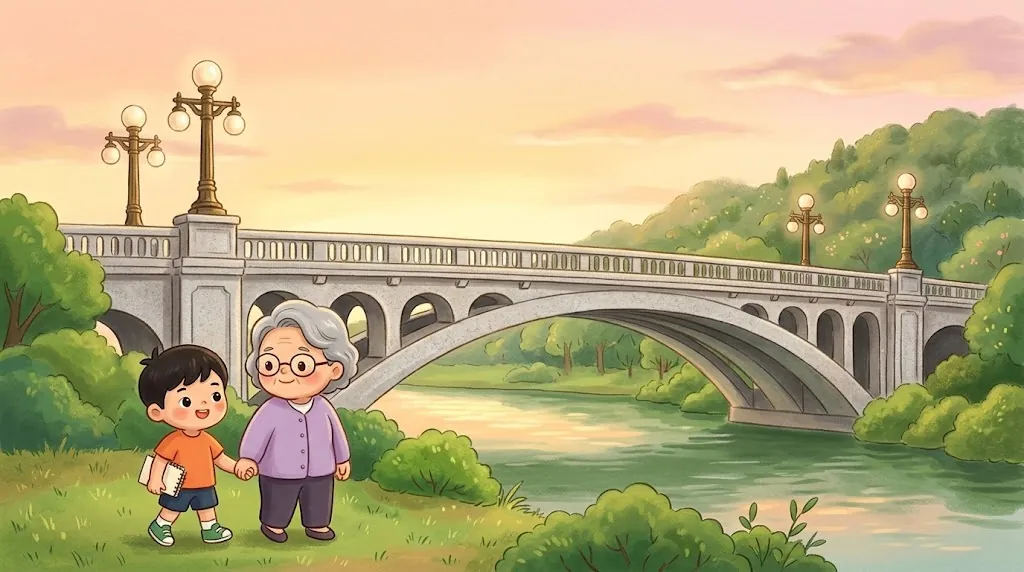
At sunset, a boy named Hao and his grandma hold hands on a riverbank and look at an elegant old gray arch bridge with bronze lamp posts.

The Bridge in 435 Pieces

This is Hao, and this is his grandma, A-ma. When A-ma was a little girl, she walked across a beautiful bridge in Taipei every week.

It was called the Meiji Bridge. But today, you can't walk on it. It lies in 435 pieces! What happened?

๐Ÿ‘† Tap the glowing circles. Tap ๐Ÿ“– Read to me to hear the story. Press Next โ–ถ to keep reading, or jump straight to the game.
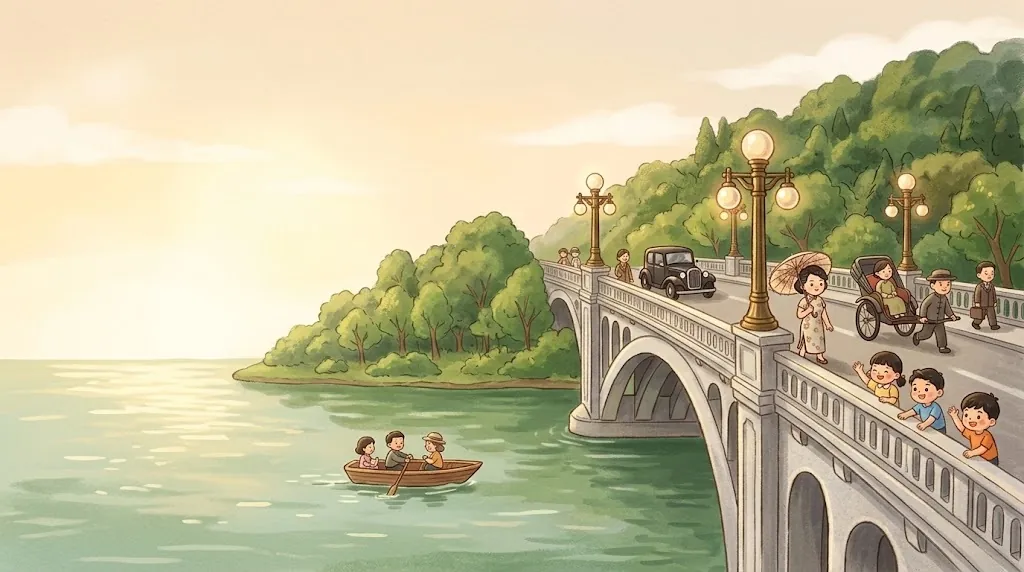
Long ago, people in old-fashioned clothes walk across the arch bridge: a lady with a parasol, a rickshaw, an old black car, and children waving, with bronze lamps shining.

The first bridge here was made of iron, in 1901. Later the river was changed, and a new bridge was built. It opened in 1933, more than 90 years ago!

The new bridge had graceful arches, a stone railing, and two pairs of shiny bronze lamps. People loved to walk across it. ๐Ÿ‘† Tap around.

๐ŸŒ‰ The bridge led from the city to a hill by the river, where today's Grand Hotel stands. It was about 17 m wide, wider than most streets back then.
How does an arch stand up?

An arch is made of stones shaped like wedges. Builders put them on a wooden frame, starting from the bottom on both sides.

The last stone goes at the very top: the keystone. Now the stones push on each other and hold each other up, and the frame can come away! ๐Ÿ‘† Build an arch, or try taking the frame away too early.

๐Ÿ›๏ธ People have built arches for thousands of years. The bridge's arches were made of concrete with steel inside, but they work the same way.
The bridge's long life

Over many years, the bridge changed. After 1945 it got a new name, the Zhongshan Bridge. More and more cars came, so it was made wider, and the bronze lamps were taken off.

Then, in 2002, something big happened. ๐Ÿ‘† Travel through the years.

๐Ÿš— In 1968 the bridge was widened from 17 m to 23 m, so more cars could fit. That's when the lamps and the stone railing came off.
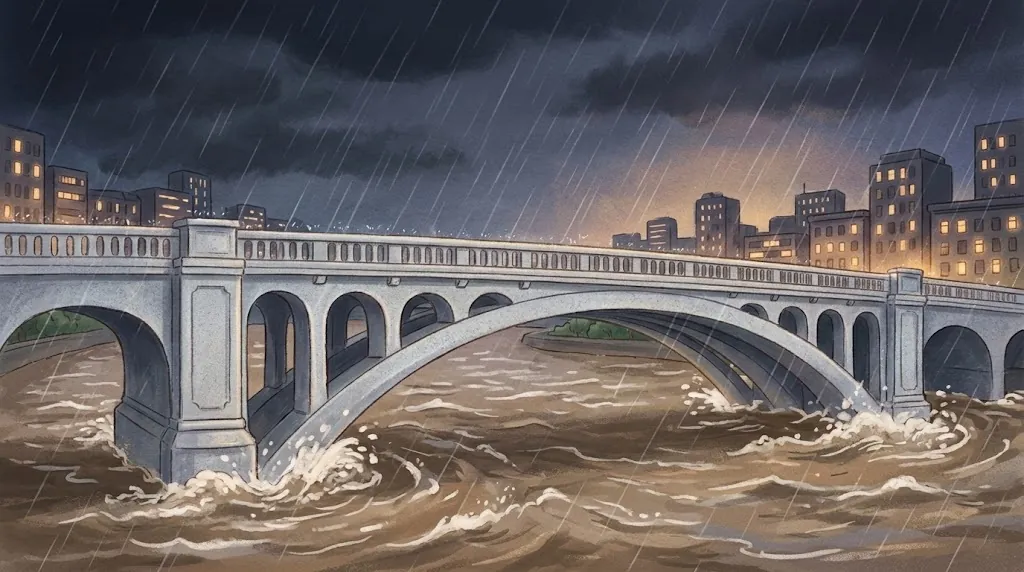
A typhoon night: heavy rain, and the muddy river rises high and squeezes between the thick piers of the bridge.

In 2001, a big storm called Typhoon Nari brought huge amounts of rain to Taipei, and many places flooded.

Here, the river is narrow. People worried that in a big flood, the old bridge's low arches and thick piers would get in the way of the water. ๐Ÿ‘† Tap around the storm.

๐ŸŒŠ A bridge must let floodwater pass underneath. If the water can't get through, it backs up and rises even higher.
Build a bridge the flood can pass

So where should a bridge be? High enough that floodwater flows under it. But not too high, or the ramps get too steep for cars.

And not too many piers in the water: each one pushes the flood a little higher. ๐Ÿ‘† Try it, then send a flood!

๐Ÿ“ Engineers look at old floods to see how high the water can get, then leave a little extra space under the bridge, just in case.
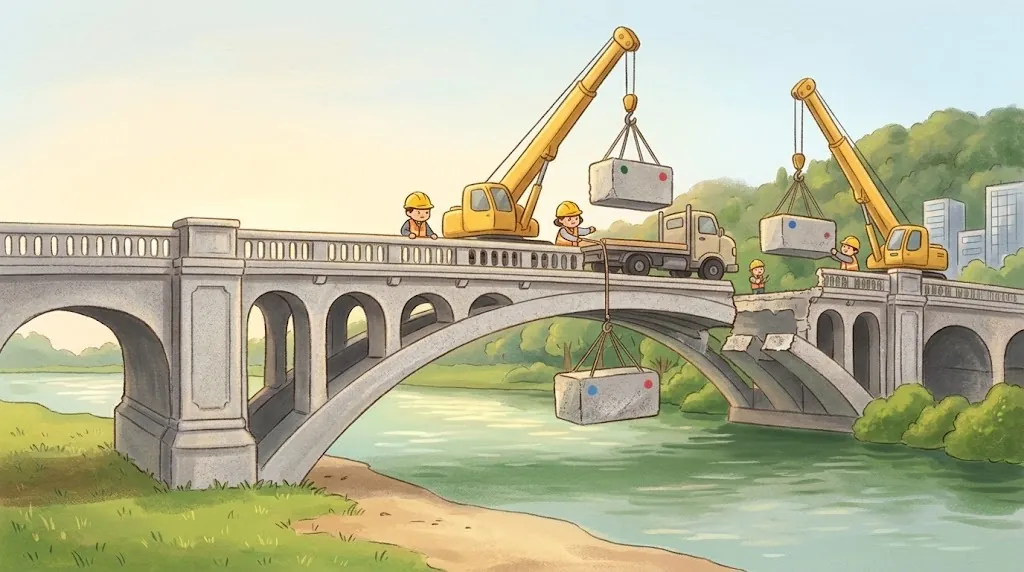
Yellow cranes carefully lift big gray blocks cut from the old bridge onto a truck, while friendly workers in hard hats guide them.

So in December 2002, workers began taking the old bridge apart. The city promised to keep it and build it again somewhere else.

They cut it into big blocks. Each block got a number, so one day it could be put back in the right place. ๐Ÿ‘† Tap around.

๐Ÿงฉ In all, the bridge became 435 pieces. That's like a giant puzzle, with pieces as heavy as cars!
๐Ÿ‘† Tap stone number 1

Why the numbers? Every piece of the bridge is a little different. A piece only fits in its own place, like a puzzle piece.

With the numbers, builders know exactly where each piece goes. ๐Ÿ‘† Tap the stones in order, 1, 2, 3..., and watch the arch come back!

๐Ÿ“ธ Builders also took photos and made drawings before taking it apart. Numbers, photos and drawings together are like the picture on a puzzle box.
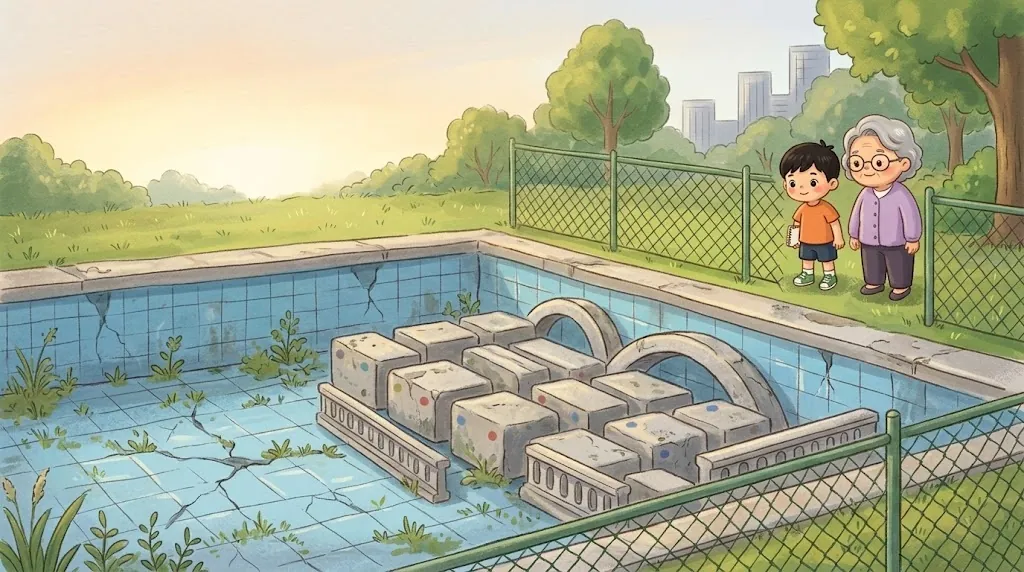
Big gray blocks from the bridge lie in rows in an old empty swimming pool with cracked blue tiles and weeds. Hao and A-ma look through the fence.

The pieces were taken to an old, empty swimming pool, and there they lie. Grass grows between them.

It has been more than 20 years. Why so long? Finding the right place is hard: it needs lots of space, it shouldn't block a river, and putting the pieces back together is tricky. ๐Ÿ‘† Tap around.

๐Ÿท๏ธ In 2004 the bridge became an official historic building, even in pieces. Over the years, the city looked at 16 places for it, but none was quite right.
If it were up to you, where would it go?

Now people in Taipei are talking about it again. Should the bridge be put back together? Where?

Every idea has good parts and hard parts. There isn't one right answer: people share ideas, listen to each other, and then decide together. ๐Ÿ‘† Look at each idea.

๐Ÿ—ณ๏ธ When a city decides something big, many people help: experts, students, neighbors, and the people everyone votes for.
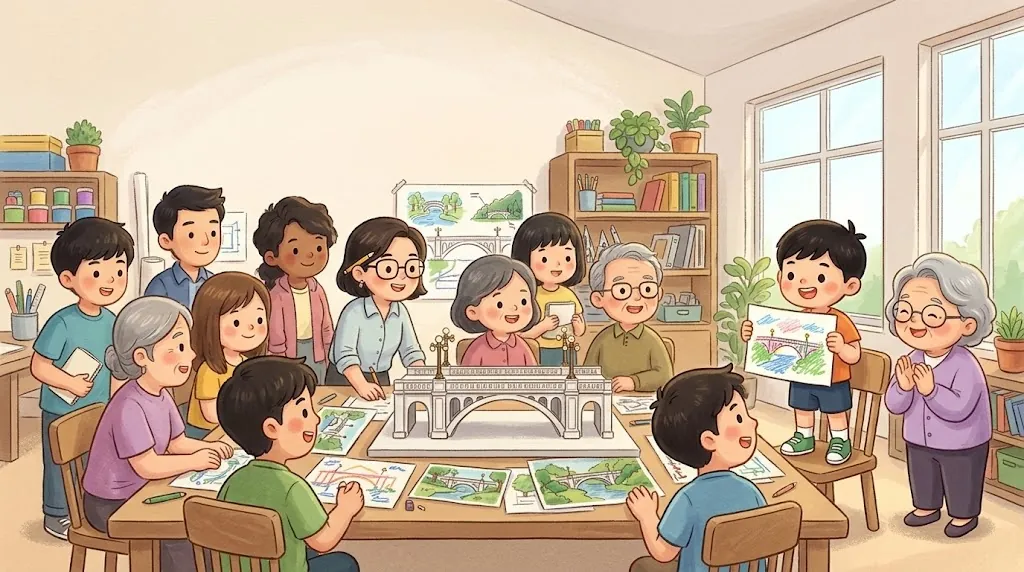
In a bright room, students, an architect and neighbors gather around a model of the arch bridge and colorful drawings, while Hao stands on a chair holding up his own drawing.

In 2026, the city invited experts, university students and neighbors to look at the pieces and share ideas. Hao brought his drawing too!

The city plans to finish a report about how the bridge could be put back together in January 2027. Maybe, one day, A-ma and Hao will walk across it together. ๐Ÿ‘† Tap around.

โœ๏ธ What would you draw? A bridge over a pond? A bridge you can walk under? Your idea counts too!

How to play Bridge Puzzle!

  1. ๐Ÿงฑ Arch: drag each numbered stone to the slot with the same number (or tap the stone, then the slot). Build up from both sides; the keystone goes last. Then take the frame away!
  2. ๐Ÿ” Find: tap the pieces in the pool in order. Tap a tarp to lift it.
  3. ๐ŸŒŠ Flood: pick the bridge's height and its piers, then press Test. The water must pass under it, and cars must get up the ramps.
๐ŸŽฎ Play Bridge Puzzle! 8 missions, from your first arch to Opening Day, plus Free Build. Your stars are saved on this device.
Hao and A-ma look at the old arch bridge at sunset.

You Know the Meiji Bridge!

Taipei's Meiji Bridge opened in 1933 with graceful arches and bronze lamps. In 2002 it was taken apart into 435 numbered pieces to help the river during floods. Today people are working out how and where to put it back together.

๐Ÿง  Quick Quiz!

1. Which stone goes into an arch last?
2. Why did each piece get a number?
3. What must a bridge over a river let pass underneath?
๐ŸŒ‰ Try it with a grown-up: stand two books up and lean them against each other at the top. That's a tiny arch! What happens if you pull one away?
Sources: ไธญๅฑฑๆฉ‹ (่‡บๅŒ—ๅธ‚) (the iron truss bridge of 1901; the reinforced-concrete arch bridge built from January 1930 and finished in March 1933, about 17 m wide with a granite railing and two pairs of bronze lamp posts; renamed Zhongshan Bridge in 1946; widened to 23 m in 1968 when the lamps and railing came off; after Typhoon Nari in 2001, the 2002 decision to move it for water and heritage reasons; taken apart from 20 December 2002 into 435 pieces stored at the old Zaichun swimming pool; a historic building from 2004; the new Zhongshan Bridge opened in 2007) ยท CNA, 16 September 2026 (the 435 pieces at the old Zaichun pool, the 2020 restoration plan, the expert forum, site walk and student workshop in 2026, and the reassembly concept report planned for January 2027) ยท Epoch Times, 25 October 2026 (16 places studied, the pieces cut vertically, river law limits near the water) ยท Spectral Codex, Taipei Zhongshan Bridge (completed in 1933, widened in 1968, dismantled in late 2002 into 435 pieces, historic building in 2004)
Hao, A-ma and their story are pretend. The pictures are drawn from imagination, not exact copies of the real bridge (for example, how many arches it had). Sources give its length as about 93 m or 120 m. The arch and flood pages are simplified: the real arches were concrete with steel inside, and how much the old bridge affected floods was argued about for years, so the book only says people worried about it. The ideas on page 10 are examples, not the city's real plans.