๐ŸชถBomi the Spoonbill
๐ŸŽฎ Play
At sunset over the fish ponds of Tainan, Bomi the black-faced spoonbill flies in with spread wings, and Ting, a girl with binoculars, waves from a pond bank.

Bomi the Black-faced Spoonbill

Every autumn, special birds fly all the way to Taiwan for the winter. They have black faces and bills shaped like spoons!

This is Bomi, a black-faced spoonbill. And this is Ting, who loves watching birds in Tainan. Let's follow Bomi's year!

๐Ÿ‘† Tap the glowing circles. Tap ๐Ÿ“– Read to me to hear the story. Press Next โ–ถ to keep reading, or jump straight to the game.

Bomi stands in shallow water showing its long black bill with a round spoon at the tip. Behind it, another spoonbill sleeps standing on one leg.

Look at Bomi's bill: long and flat, with a round spoon at the tip! In Taiwanese, people call these birds "rice-paddle birds" (้ฃฏๅŒ™้ณฅ), because the bill looks like the paddle you use to scoop rice.

There are six kinds of spoonbills in the world. The black-faced spoonbill is the smallest one. ๐Ÿ‘† Tap around.

๐Ÿ“ From the tip of its bill to the end of its tail, a black-faced spoonbill is about 75 cm long, about as long as a guitar.
On a grassy ledge of a rocky island, two fluffy white chicks with pink bills sit in a nest while a parent with yellow chest feathers feeds them.

Bomi hatched far to the north, on a small rocky island off the coast of Korea. That's where most black-faced spoonbills build their nests.

Mom and Dad take turns keeping the eggs warm. Baby spoonbills have pink bills! Their bills turn black as they grow up. ๐Ÿ‘† Tap the chicks.

๐Ÿฅš Eggs are laid in May and June. The parents feed their chicks for about 40 days, until they are big enough to fly.
From Korea to Taiwan

In autumn, the north gets cold, and the shallow water where spoonbills find food starts to freeze. So in October, Bomi flies south! The cool northeast monsoon wind gives a push.

Many spoonbills cross the Yellow Sea to China's coast, rest and eat at wetlands along the way, then fly on to Taiwan. ๐Ÿ‘† Fly the route!

๐Ÿ›ฐ๏ธ Scientists put tiny trackers on some young spoonbills. On average, they flew about 1,200 km from Korea to their winter homes, about 3 times the length of Taiwan, and rested 2 or 3 times on the way.
A big flock of black-faced spoonbills rests on a sandbar at a river mouth. Many sleep standing on one leg with their bills tucked into their feathers.

Bomi arrives in Tainan! During the day, the spoonbills rest together in big flocks at river mouths and lagoons, where people don't bother them.

Many sleep standing on one leg, with their bills tucked into their back feathers. ๐Ÿ‘† Find the sleepy birds.

๐Ÿ“… Black-faced spoonbills stay in Taiwan for about half a year: they arrive in autumn and fly north again in spring.
Can Bomi catch a fish without looking?

How does Bomi catch fish? It puts its spoon bill in shallow water, and sweeps it from side to side. Swish, swish! When the bill touches a fish, it snaps shut. Gulp!

Bomi doesn't need to see the fish. Its bill can feel them! ๐Ÿ‘† Sweep the bill.

๐Ÿ’ง Spoonbills like to feed where the water is shallow: about 16 cm deep or less, a bit shorter than a school ruler.
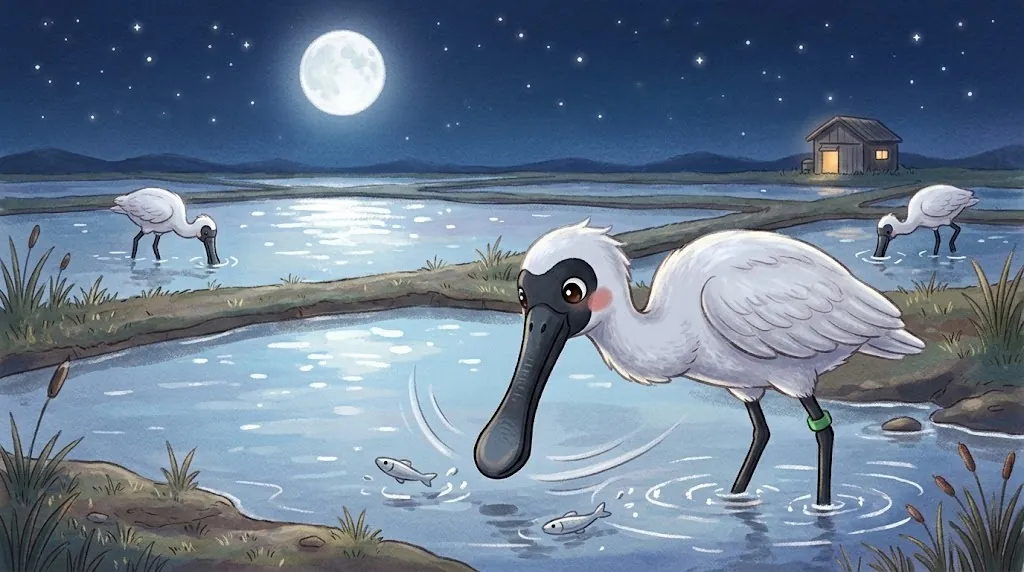
Under a full moon, Bomi wades in a shallow fish pond, sweeping its bill through the silver water, with small fish darting nearby.

Most of Bomi's eating happens at night! When the sun goes down, the spoonbills fly from their resting place to shallow fish ponds and wetlands nearby.

In the dark, they sweep and feel, sweep and feel, until morning. ๐Ÿ‘† Tap around the pond.

๐ŸŒ™ In Tainan, spoonbills fly about 8 km each evening to their feeding spots, and some fly as far as 15 km.
At a fish farm, A-gong in a straw hat stands by a water gate next to a drained pond full of puddles with little fish, while Ting points at spoonbills flying down to feed.
After the fish harvest...

Ting's grandpa, A-gong, raises fish in ponds. After he harvests his fish, he lets the water out, so the pond can dry in the sun.

The water gets shallow, and lots of little fish are left behind. For spoonbills, that's a feast! ๐Ÿ‘† Open the gate.

๐Ÿค In Taiwan, some fish farmers get a thank-you payment for keeping their drained ponds safe for spoonbills to feed in, with no poison and no nets.
How many are there in the whole world?

About 35 years ago, black-faced spoonbills almost disappeared. In 1989, people counted only 288 in the whole world!

People in many countries worked together: they protected wetlands and nesting islands, and counted the birds every winter. Now there are more than 7,700! ๐Ÿ‘† Watch the numbers grow.

๐Ÿ”ข Every January, bird watchers in many countries count spoonbills on the same days. It's called the global census.
If there were only 100 spoonbills...

Where do all the black-faced spoonbills spend the winter? If the whole world had just 100 of them, about 61 would be in Taiwan!

That means Taiwan has a very important job: keeping these birds safe every winter. ๐Ÿ‘† Tap the places.

๐Ÿ“ In the January 2026 count, Taiwan had 4,719 spoonbills. Tainan had 2,034, and Chiayi had 1,515.
The resting flock of spoonbills on the sandbar.
T85
N44
N49
Bomi ๐ŸŸข
๐Ÿ‘† Tap the birds' legs to read their rings!

Some spoonbills wear a little ring on their leg, with letters and numbers on it. Bird watchers read the rings through telescopes, so they know who's who.

A spoonbill named T85 was rescued, got better, and was set free. It has come back to Tainan for three winters in a row! ๐Ÿ‘† Read the rings.

๐Ÿ”ญ The rings don't hurt. They help scientists learn where each bird goes and how long it lives.
In spring, Bomi with a fluffy yellow crest and a yellow chest patch flies north over the sea, followed by other spoonbills, while Ting waves goodbye from the shore.

When spring comes, grown-up spoonbills get dressed up! They grow fluffy yellow feathers on the back of the head, and a yellow patch on the chest.

Then, starting around March, they fly north in small groups, back to the islands to build nests. Bye, Bomi! See you next winter! ๐Ÿ‘† Wave goodbye.

๐ŸŽ‚ Young spoonbills don't get yellow feathers yet. They grow them when they are about 3 or 4 years old.
In a wooden birdwatching pavilion, Ting looks through binoculars and puts a finger to her lips while A-gong sets up a telescope. Far away, the spoonbills rest calmly.
How can we help?

Ting and A-gong go to a birdwatching hut. They watch the spoonbills from far away with binoculars, and stay quiet. If people get too close, the birds fly away and waste the energy they need.

Every autumn, Tainan holds a spoonbill festival to welcome them back. ๐Ÿ‘† Tap the ways to help.

๐Ÿฆบ Spoonbills are protected in Taiwan. Keeping wetlands clean and safe helps many other birds too.

How to play Spoonbill Journey!

  1. ๐ŸŸ Feed missions: hold your finger on the water, and Bomi walks there, sweeping its spoon bill. When the bill touches a fish: gulp!
  2. Walk slowly, or the fish swim away. Dark blue water is too deep for Bomi's legs.
  3. ๐Ÿ•Š๏ธ Fly missions: touch where you want Bomi to fly. Rest in the green wetlands, and fly around the gray rain clouds.
  4. Eat enough before sunrise, and reach Taiwan (or Korea in spring) without getting too tired!
๐ŸŽฎ Play Spoonbill Journey! 8 missions, from your first swish to the long flight across the Yellow Sea, plus Free Feeding. Your stars are saved on this device.
Bomi flying over the fish ponds at sunset.

You Know Spoonbills!

Black-faced spoonbills nest near Korea and spend the winter in places like Tainan. They catch fish by touch with their spoon bills, mostly at night, and they came back from only 288 birds thanks to people working together.

๐Ÿง  Quick Quiz!

1. How does a spoonbill find fish?
2. When do spoonbills do most of their eating?
3. How should we watch spoonbills?
๐Ÿ”ญ Try it with a grown-up: visit a birdwatching spot in Tainan's Qigu between October and March, and bring binoculars. How many spoonbills can you count?
Sources: Chinese Wild Bird Federation, 2026 global census results (7,746 birds; Taiwan 4,719, about 61%; Tainan 2,034; Chiayi 1,515; China 1,849; Japan 757; Hong Kong and Shenzhen 291; Vietnam 72; South Korea 39; Macau 12; Philippines 7) ยท Black-faced spoonbill (smallest of six spoonbills, about 288 birds counted in 1988 to 1990, nesting on islands off Korea, sweeping by touch, yellow breeding feathers at 3 to 4 years) ยท PanSci, the spoonbill's winter home (rice-paddle bird, pink chick bills, about 40 days of feeding, night feeding in water under about 16 cm, flying about 8 km and up to 15 km, arriving in October and leaving from March) ยท EAAF Partnership, Korean tracking of black-faced spoonbills (crossing the Yellow Sea to China's coast) ยท Korean satellite tracking of juveniles (about 1,201 km on average, 2 to 3 stopovers) ยท Black-faced Spoonbill Conservation Association (body length 71 to 83 cm) ยท Newtalk, October 2026 (spoonbills arriving in Tainan, the 2026 conservation festival, rings T85, N44 and N49 back three years in a row) ยท AgriHarvest, 2026 census and payments to fish farmers
Bomi, Ting and A-gong are pretend, and the faces are just for fun. Real rings have codes, but Bomi's green ring is pretend. Numbers are rounded for kids: 61 of 100 is Taiwan's 61%; 24 of 100 China (1,849); 10 of 100 Japan (757); the other 5 are Hong Kong and Shenzhen, Vietnam, South Korea, Macau and the Philippines. The map on page 4 is simplified, and the route shows one common way; spoonbills also fly other routes.