๐Ÿš€Emmy's Trip to Phobos
๐ŸŽฎ Play
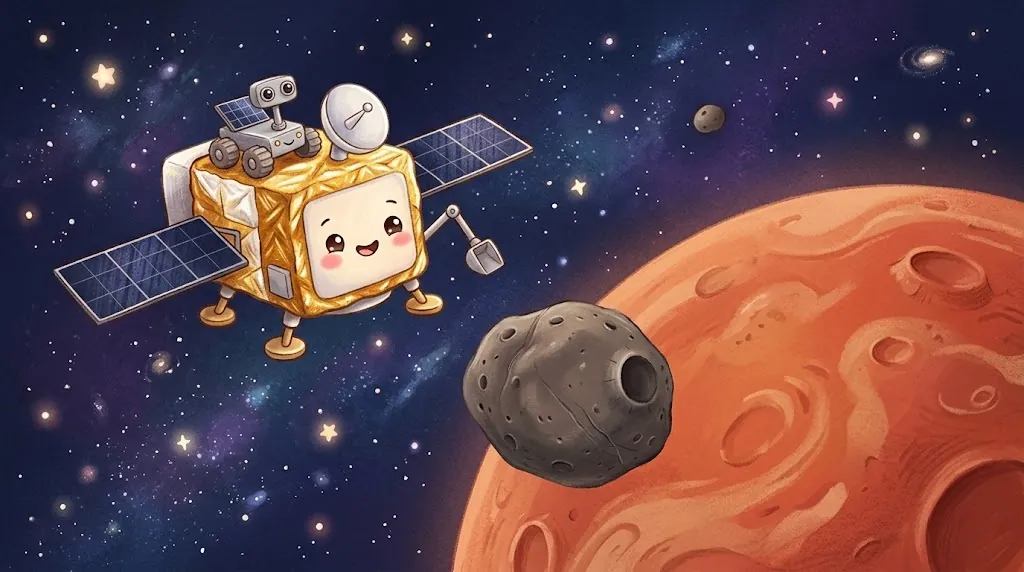
Emmy, a cute golden box-shaped spacecraft with solar panels and a little scoop arm, flies through space carrying the rover Idefix on its back, toward the gray potato-shaped moon Phobos in front of the big red planet Mars.

Emmy's Trip to Phobos

Mars, the red planet, has two tiny moons. One of them is called Phobos. It is shaped like a potato!

In October 2026, a spacecraft from Japan set off to visit it. Its real name is MMX, but let's call it Emmy. Emmy's job: scoop up some Phobos soil and bring it home to Earth!

๐Ÿ‘† Tap the glowing circles. Tap ๐Ÿ“– Read to me to hear the story. Press Next โ–ถ to keep reading, or jump straight to the game.
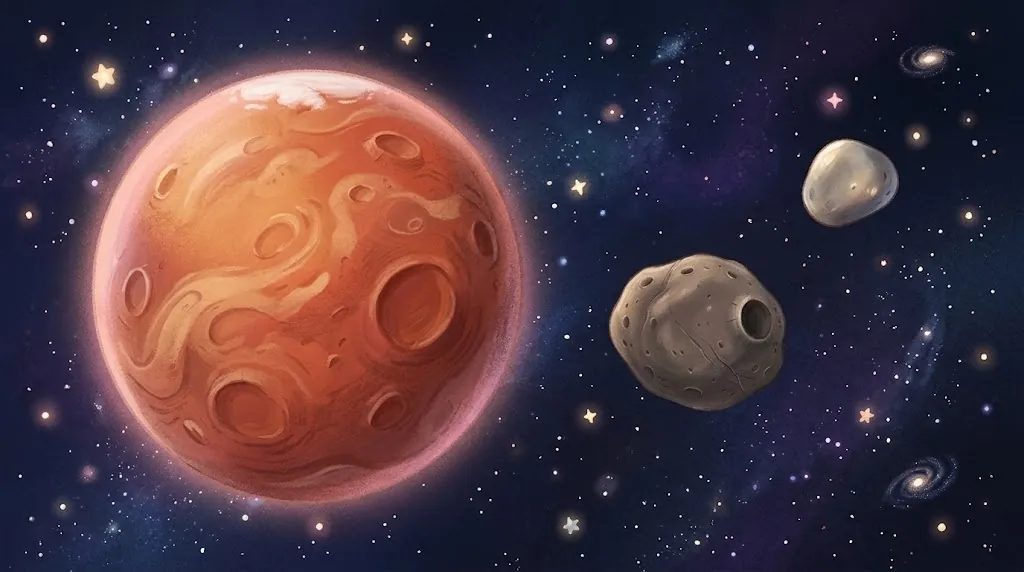
The red planet Mars with a white ice cap at the top, and its two small lumpy moons: gray Phobos with a big crater, and smaller, smoother Deimos farther away.

Our Moon is round and big. But Mars's moons are small and lumpy, like potatoes. Their names are Phobos and Deimos.

Phobos is the bigger one, and it is very close to Mars. ๐Ÿ‘† Tap the planet and the moons.

๐Ÿ“ Phobos is only about 22 km across. A car on a highway could drive past it in about 15 minutes! Our Moon is about 160 times wider.
Who goes around Mars faster?

Phobos is a speedy moon! It goes all the way around Mars in about 7 and a half hours. That's about 3 times in one Mars day.

Deimos is far away and slow: it takes more than a day. ๐Ÿ‘† Run one Mars day and count!

๐ŸŒ… From the ground on Mars, Phobos rises in the west and sets in the east, the opposite way from our Sun and Moon. It moves so fast it passes Mars's turning!
At dawn on the island of Tanegashima, a big white H3 rocket lifts off with a bright flame, while a boy named Riku holding a toy rocket jumps for joy on the black sand beach next to his mom.
Tanegashima, Japan

Riku and his mom woke up very early to watch. On October 20, 2026, before sunrise, a big H3 rocket lifted off from Tanegashima Island in Japan, carrying Emmy!

"3, 2, 1... Liftoff!" ๐Ÿ‘† Count down with Riku.

๐Ÿงณ Emmy weighs about 4,500 kg, as heavy as three cars. Most of that is fuel for the long trip there and back.
Earth to Mars

Mars is very far away. Emmy can't fly straight there. It goes around the Sun in a big curve, and meets Mars when Mars comes around.

The trip takes about 10 months. Emmy should reach Mars in August 2027. ๐Ÿ‘† Fly the curve!

๐ŸŽฏ It's like throwing a ball to a friend who is running: you throw to where your friend will be, not where they are now.
Where did Phobos come from?

Here is a mystery: nobody knows where Phobos came from! Scientists have two big ideas.

Idea 1: Phobos was an asteroid that flew too close, and Mars caught it. Idea 2: Something huge crashed into Mars long ago, and the pieces that flew up stuck together. ๐Ÿ‘† Watch both ideas.

๐Ÿ” The soil can tell! If it's made of the same stuff as Mars, Idea 2 wins. If it's like asteroid rock, Idea 1 wins. That's why Emmy is bringing some home.
Same jump, two places

Phobos is so small that it hardly pulls on anything. On Phobos, Riku would feel super light, as light as a handful of paper clips!

If he jumped as hard as he can on Earth, on Phobos he would float up hundreds of meters, about as high as Taipei 101, and take many minutes to come down. ๐Ÿ‘† Jump in both places.

โš ๏ธ That's why landing is tricky! Land too fast, and you bounce away. Emmy has to come down very, very gently.
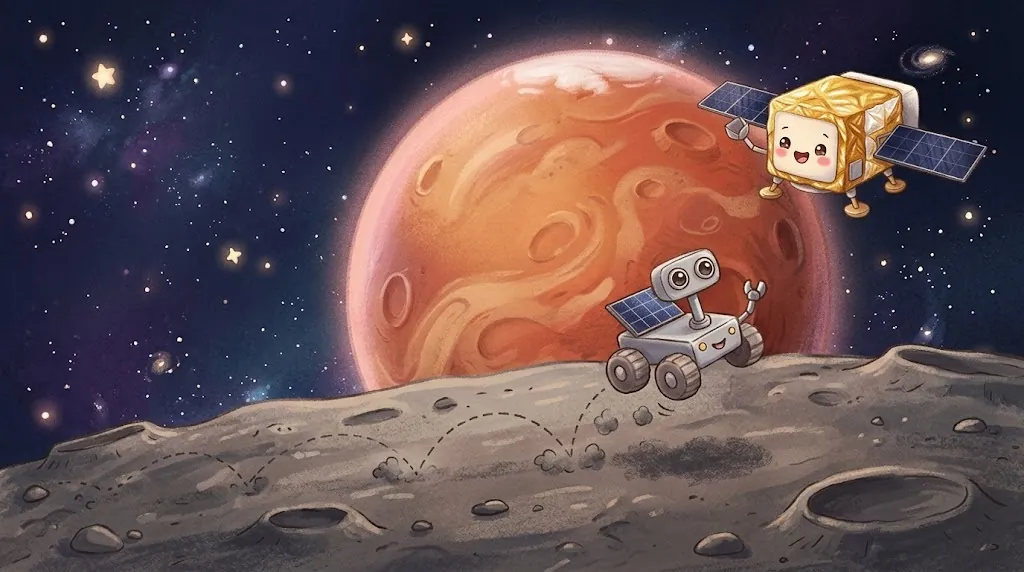
The little rover Idefix bounces across the gray dusty ground of Phobos, leaving a dotted path of hops, while Emmy waves from above and big red Mars fills the sky.

Emmy has a little friend on its back: a rover named Idefix! It was built by France and Germany.

Before Emmy lands, it lets Idefix go. Idefix has no landing legs. It just drops, then bounces, boing... boing... until it stops. Then it stands up and drives, very slowly. ๐Ÿ‘† Tap around.

๐Ÿ”ฌ Idefix weighs less than 30 kg. It will look at the soil with its cameras, and check if Phobos is a safe place for Emmy to land.
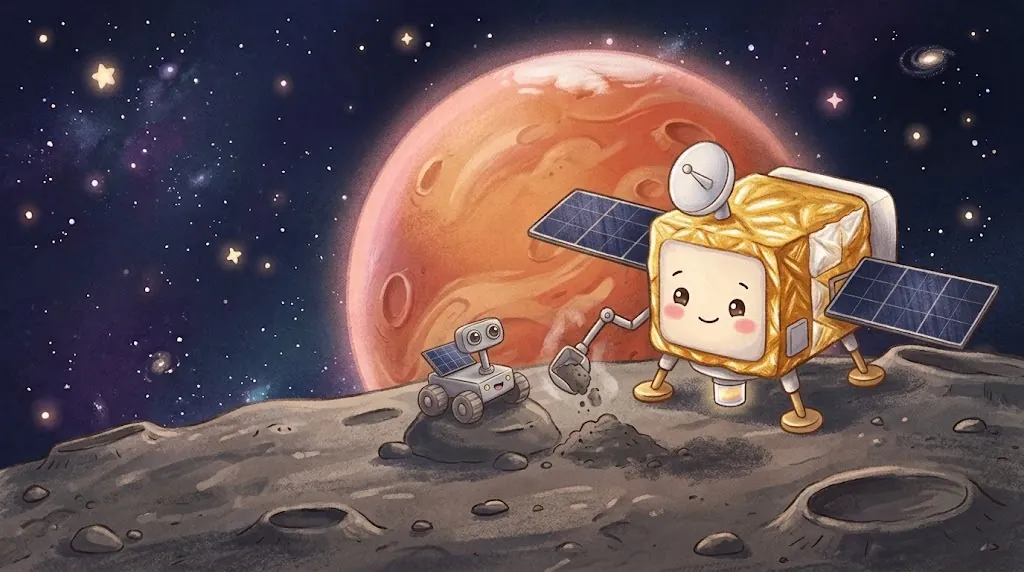
Emmy has landed on Phobos with its legs on the gray ground and is scooping soil with its arm, while Idefix watches from a rock nearby. Mars glows behind them.
๐Ÿฅ„ Soil collected: 0 g

Emmy lands for just a few hours. Time to scoop! It has two ways: an arm that pushes a tube into the ground to dig, and a gun that puffs air to blow soil into a box.

Emmy needs at least 10 grams, about as heavy as two or three sugar cubes. ๐Ÿ‘† Help Emmy collect it!

๐Ÿ•‘ The whole scooping job is planned to take about 2 and a half hours. Then Emmy takes off again, gently!
๐Ÿ‘† Tap Phobos to explore

Look at that giant hole! It is a crater called Stickney, about 9 km wide. Something hit Phobos so hard it almost broke apart!

And here is a surprise: Phobos is very, very slowly getting closer to Mars. One day, millions and millions of years from now, Mars may pull it apart into a ring. ๐Ÿ‘† Explore Phobos.

๐ŸŒ Phobos comes closer to Mars by about 2 meters every 100 years. That's much slower than a snail!
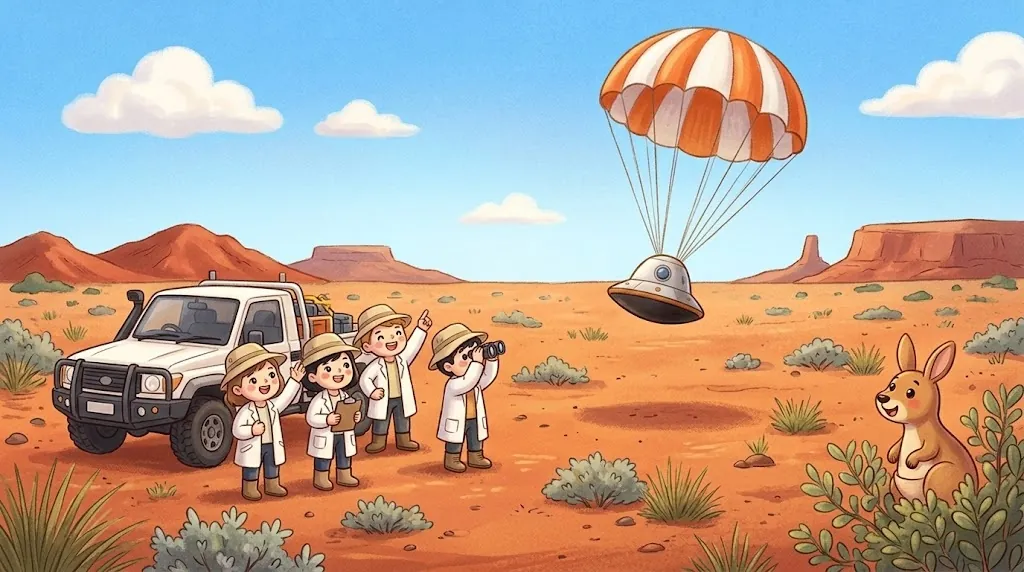
A small capsule floats down under an orange and white parachute over the red desert of Australia, while a team of scientists in white coats and hats waves and points next to their truck, and a kangaroo watches from the bushes.

After exploring, Emmy flies back toward Earth. Near home, it drops a small capsule with the soil inside.

The capsule zooms through the air, glowing hot. Then, pop! A parachute opens, and it lands softly in the desert of South Australia, in 2031. ๐Ÿ‘† Tap around.

๐Ÿ‡ฏ๐Ÿ‡ต Japan has done this before! The Hayabusa2 capsule landed in the same desert in 2020, with soil from the asteroid Ryugu.
How old are you now? ๐Ÿ‘‡

Emmy's whole trip takes about 5 years. When the Phobos soil lands in Australia, how old will you be?

Maybe one day, you'll be the scientist who looks at the Phobos soil and solves the mystery! ๐Ÿ‘† Pick your age.

๐Ÿ“… 2026: liftoff ยท 2027: reach Mars ยท 2027 to 2030: explore Phobos (and visit Deimos) ยท 2031: the capsule comes home.

How to play Moon Scoop!

  1. ๐Ÿ›ฌ Land: hold โ–ฒ UP to slow down and โ—€ โ–ถ to slide. Come down gently on the green glow, then hold SCOOP.
  2. Too fast? Boing! On Phobos you bounce very high. Little taps work best, and watch your fuel.
  3. ๐Ÿค– Rover: hold GO to drive Idefix. Go slowly over bumps, stop next to a sparkly rock and hold SCAN.
  4. ๐Ÿช‚ Home: wait for the yellow line, open the parachute, and steer into the landing zone in Australia.
๐ŸŽฎ Play Moon Scoop! 8 missions, from your first touchdown to the trip home, plus Free Landing. Your stars are saved on this device.
Emmy scooping soil on Phobos with Idefix nearby.

You Know Phobos!

Phobos is a tiny, potato-shaped moon that zips around Mars. Its gravity is super weak, so landing has to be gentle. Emmy (MMX) will scoop its soil and bring it to Australia in 2031, to find out where Phobos came from.

๐Ÿง  Quick Quiz!

1. What shape is Phobos?
2. Why must Emmy land very gently?
3. Where will the capsule land?
๐Ÿ”ญ Try it with a grown-up: on a clear night, look for a reddish "star" that doesn't twinkle much. That might be Mars! (Phobos is far too small to see without a big telescope.)
Sources: ESA, MMX lifts off to Mars's moon Phobos (04:41 JST on 20 October 2026, H3, Tanegashima) ยท ESA, the MMX mission (samples land in the Woomera area of Australia in 2031) ยท Martian Moons eXploration (about 4,480 kg, Mars in August 2027, at least 10 g of soil, coring and pneumatic samplers, about 2.5 hours of sampling, the Idefix rover under 30 kg from CNES and DLR that bounces after release, Deimos flybys, return in 2031) ยท Phobos (about 27 ร— 22 ร— 18 km, an orbit of 7 h 39 min, rising in the west, Stickney crater about 9 km, moving closer to Mars by about 1.8 m per century, the two ideas about its origin) ยท Deimos (an orbit of about 30 hours) ยท Australian Space Agency (the JAXA partnership for Phobos samples landing in South Australia in 2031; Hayabusa2 landed at Woomera in 2020)
Emmy, Riku and the faces are pretend; "Emmy" is just a nickname for MMX. Numbers are rounded for kids: Phobos's average width is about 22 km; a Mars day is about 24 hours and 40 minutes, so Phobos goes around a little more than 3 times. The jump on page 7 assumes a strong kid's jump on Earth of about 30 cm; Phobos's pull is different in different places, and a very fast jump could even fly off into space. The pictures on pages 3, 5 and 6 are not to scale. The landing on Phobos is planned for 2029 or 2030, so the timeline on page 12 is approximate.